Friday, 2 August 2013

London Lessons (aka Note to Self)

I loved our two weeks in London!  So it is perhaps picky of me to imagine that I might have improved this holiday in any way.  But upon reflection, I realize that there are a few things that I might have done better.  Next time I promise that I will:

1. Do more homework. It is shameful that as a librarian I didn't do a teeny bit more research about the places we were visiting.  There are fabulous websites for every museum, gallery and park in London and I didn't really appreciate them until I was back in Guelph reminding myself of where had been and what we had done.  I have the time and skills to do more research, so in the future I promise to embrace the "getting ready is half the fun" attitude.


2. Read reviews, but better yet, talk to someone who has actually been to a theatre event before I shell out big bucks (or big pounds in our case) for tickets.  On the strength of a Tony nomination in NY, we went to a matinee performance of Mathilda, the musical based on Roald Dahl's children's book.

the stage
The staging for Mathilda was very impressive.
I think it was quite good.  But I couldn't really understand half of the dialogue or most of the music. If only someone had warned us about the accents.  All that singing.  All those children.  All those British children singing complicated songs. It was wasted on my aging North American ears.  I would have been better off going to see Helen Mirren in The Audience.    

3.  Check a British calendar for Bank Holidays and plan to sit tight on those days.  Travelling in England in 1964, I was thrown for a loop by this mysterious (to me) day-off.  A Bank what?  Is that why I can't find a place to sit on the train?  Darn!  I forgive my non-swearing, 20-year old self for ignorance about this British weekend-extender.  Back in the Dark Ages, how could I have possibly known?  But in 2013 when Google tells all, we should have been prepared.  We could have avoided playing sardines on the train to the Lake District.  Or shopped for dinner before Waitrose's 4:00 pm Bank Holiday closing. Not that our pub meal wasn't delicious...

4.  Do not place any faith in the 14-day forecast.  If the Weather Network offers a range of London temperatures from 12 to 16 degrees C along with the possibility of rain, accept that most of the days will be cool ones and that rain is pretty much guaranteed. Pack an extra sweater, and a hat, gloves and scarf!  Stop being so optimistic.


 ***
I wonder if any of this advice applies to our two-week-long September hiking trip in Spain?   I wish I could have a word with myself 5 weeks from now. I'd love to know what I would include in  Spanish Lessons:  Note to Self.

Friday, 19 July 2013

Lake District Weekend


Our Lake District (aka Cumbria) getaway with John and Anne was superior in every respect. We had great weather, (sunshine at last!), and although it was a Bank Holiday Weekend, we hardly noticed.  We had been squashed on the train to Windermere with all the other holiday makers, but we felt like the only tourists in town when we drove our rental car up to Rose Cottage in the village of Witherslack at the southern edge of the district.

We had been looking for self-catering accommodation for four, and in a tourist area that specializes in B&B's we considered ourselves lucky to have found this charming short-term rental in a place we would otherwise have avoided.  Because, honestly, who would ever think "Witherslack! Yippee! Now there is a place that really sounds interesting!"

Spring is late this year.  Rose Cottage has no roses yet.
Our intention was to go on a couple of walks and do a bit of exploring by car. But we also thoroughly explored the little roads around Witherslack, especially the one that leads to the pub, the village's only amenity.  (There is also a community shop but it never seemed to be open.  We did all our grocery shopping in Windermere, about 20 minutes away.)
The pub is just down the road.

Some kind of yellow anemone adorns one of many stone walls.


Looking back down the road at a gorse hedge in full bloom.

The Derby Arms, our destination at dusk.
There is plenty of exciting hiking in Cumbria, but we settled for a couple of less adrenaline-pumping walks.  We didn't have time for all-day excursions.  Our 3-hour rambles presented no cliffs to scale, and no ledges to traverse, but we did see some very lovely pastoral scenery.

No daffodils, but a host of woodland bluebells were a beautiful sight.
As we walked along through property near Coniston that had once been owned by Beatrix Potter, we learned that when 19th century Lake District dwellers realized that they were onto a good thing scenery-wise, they were not above adding the occasional prettifying detail.  A stone fence here, a charming building there, and don't forget to throw in a few sheep!    The tourists will love the sheep!

Aaaah...ewes and lambs.
                                                                                    
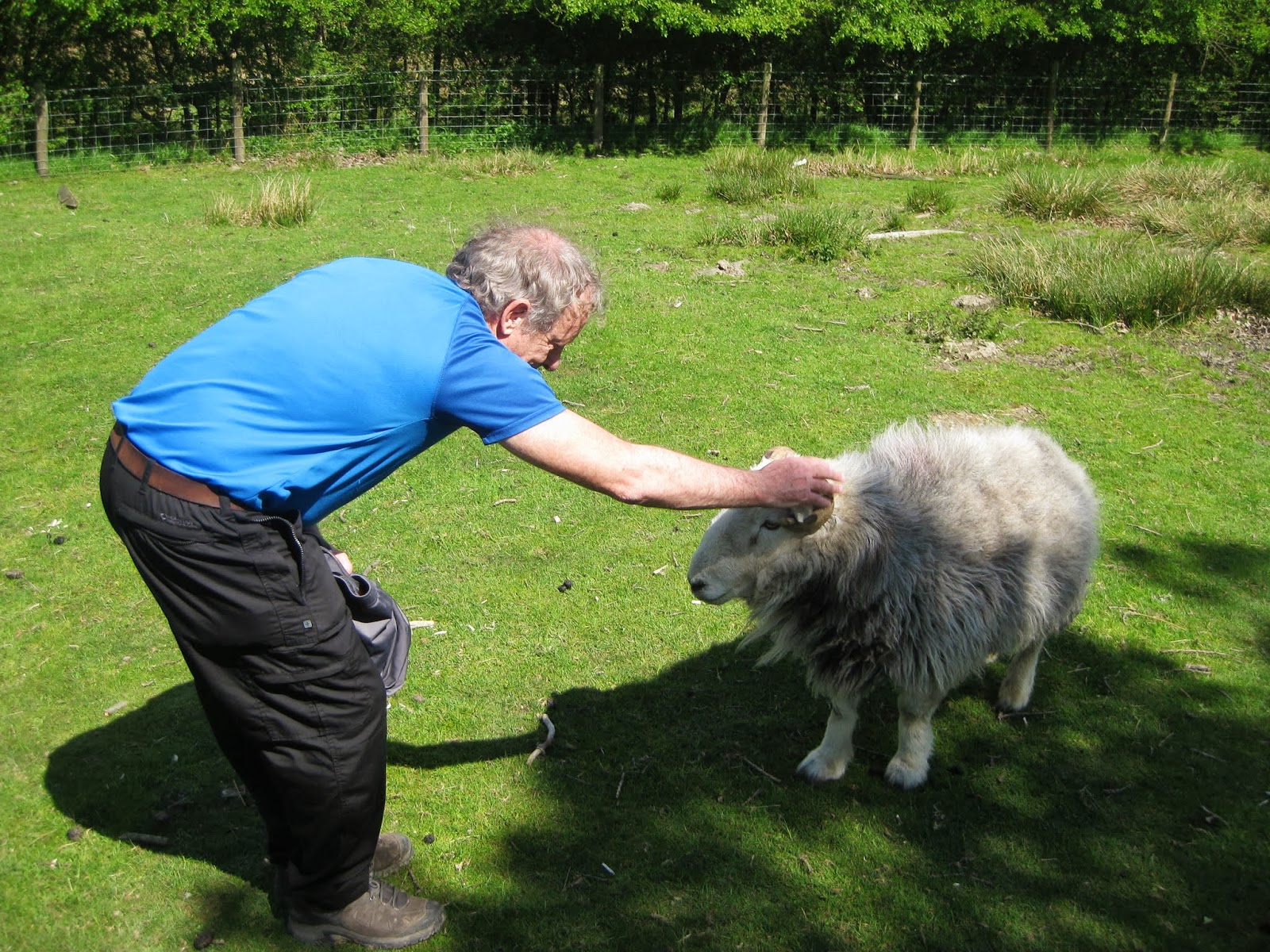
Anne's brother Gareth came on our walk to Tarn Hows, and was greeted by a very tame ram.
These lambs have white ears.  I could only see white ewes, but many, many adorable black offspring. Hmmmmm.....
Ullswater is the deepest lake in the LD, and there is plenty of fine walking nearby. Most hikers are heading for Helvelyan, the third highest mountain in England.  We went part of the way on this trail.  

On the hills above Ullswater
Bruce consults with puzzled walkers. 


Take my word for it.  There were sheep grazing here until a FOX scooted by. 
Our day ended with a trip to Keswick.  We whizzed through town and headed to Castlerigg
 -- a sort of miniature Stonehenge.  I was surprised that so few other people were investigating this historic site, but perhaps the English are ho-hum about such attractions because there are so many.  Kind of the way Canadians are about elk in Banff National Park. (Yaaawn.  Another giant horned ungulate......)         

Castlerigg sits on a plateau surrounded by hills.  Amazingly, there were only about 10 other visitors.

Friday, 12 July 2013

London: Must-See Museums (and Galleries)

I could very well have spent our entire holiday just roaming the galleries at the Victoria and Albert.  It would have been very enjoyable and instructive, and I would have eventually learned to find my way home on foot without getting lost.

But there was the matter of the wish-list: all those interesting places that were not top tier (no Hampton Court, no Big Ben, no London Eye), but perfect destinations now that we had more than a few days in London.

So off we went to:

The British Library.  (Yikes! How did a librarian miss this one on previous visits?)
Highly recommended to anyone who has ever read a book, or ever had an interest in History.   Magna Carta, the genuine article, is right there along with all kinds of other fascinating documents. How could I not be impressed? The library website is also superlative.
The British Library is sleek and modern.

The Courtauld Gallery.  The Courtauld, located in elegant Somerset House on "museum mile", describes itself as one of the finest little art galleries in the world, and I absolutely agree.  The collection is small and perfect, representing art from the Renaissance to the 20th century with an emphasis on Samuel Courtauld's favourites, the impressionists and post-impressionists.  The special exhibit while we were visiting was "'Young Picasso", but even with that draw, the gallery was uncrowded.  There was plenty of time to to get up close and personal with familiar paintings.  I was surprised at how many I recognized.

Even if The Courtauld is not in your immediate future, check out the amazing virtual tour and take all the time you want. You will have the gallery to yourself.
Somerset House:  the Courtauld is in there somewhere.

Looking at Manet's Bar at the Folies Bergere
Manet's A Bar at the Folies-Bergere.  You feel as if you could order a drink--if only the bar-maid looked less bored.    
       
The Saatchi Gallery.  Yes, that Saatchi, since you ask. Charles...the one who throttled his wife, Nigella Lawson, in a London restaurant.  Coincidentally, when I attempted to open the gallery website so that I could cut and paste the link, this is the message that popped up on the screen:
 Dangerous
This page on the domain saatchigallery.com contains active threats and is not recommended for browsing. The access to this website has been blocked for your protection.

Nigella needed to read something like that when she hooked up with this guy 10 years ago.

But never mind.  The gallery was fascinating: small, edgy, and contemporary. The exhibits change frequently. The one we saw was completely devoted to Russian art, and such art --weird and wonderful.   It was the only gallery where I took photos because I knew I wouldn't find these works online or in any book other than the exhibit catalog. 
In the Saatchi Gallery.  That huge painting is on stapled-together, flattened cardboard boxes.

The Tate Britain. On the strength of loving the Tate Modern, we decided to spend some time at The Tate Britain, home to British art from 1500 to the present. And we did enjoy a re-acquaintance with familiar artists we don't think about too often -- Holbein, Sergant, Whistler, Constable, Millais etc.  And then there is Turner.  The Tate has a ton of Turner.  There is a Turner room filled with some of the thousand or so Turner paintings in the collection.  I never need to see another Turner again.  Ever.

The Wallace Collection, comprising art and artifacts amassed by the Wallace family during the 18th and 19th centuries, is surely one of the most interesting galleries we visited.  First, there is the gallery itself in Hertford House, the Wallace family's former London town house.  The opulently decorated interior with its marble fireplaces, inlaid surfaces, intricate mouldings and painted ceilings is a marvel--a candy-box setting for all the pretty things the Wallaces managed to acquire.   
Home Sweet Hertford House.  The Wallace Collection lives here.
I confess to imagining the painted, pouffed, and embroidered Wallace aristocrats as a bunch of Georgian shopaholics with a taste for fancy furniture, porcelain, and rococo paintings.   I wonder what their army of parlour maids thought as they dusted yet another gilded frame,  porcelain cherub or suit of armour.  Oops...I forgot about the armour. The basement at Hertford house if full of it.  Obviously one Wallace was enamoured of half-naked shepherdesses and another got off on armour.  How interesting.  At least there was room for everything.


Fragonard's, The Swing, is part of the Wallace Collection 

Our Wallace visit was followed by a trip to (of all places) Pollock's Toy Museum. No fancy address for this assemblage of teddies, doll houses, toy cars and trains, puppets etc.  We entered a narrow old row house in Camden Town, climbed rickety stairs and found various exhibits packed into tiny rooms.  In its own way, Pollocks is just as eccentric as The Wallace.  Both museums came to be because of the particular interests that inspired these acquisitive families, although Samuel Pollock did, at least, have a toy shop in addition to his collection of old toys.
 
On our way back to Gloucester Tce. I thought of these two very different collections (and their origins), and I couldn't help but imagine practical, personal applications.  Perhaps there was no need to clean out our basement, after all. I began to envision the various exhibits that might await a curator's touch:  Ladies' Fashion in the Late 20th Century; A Fisher-Price Fantasy; Technology: 1980-2005;  Barbie and Friends Through the Years. And that's just a start. There is plenty more.  I could even stipulate in my will that our daughters take on development of The Ryan Collection -- after all, one is a librarian, and the other has a degree in museum studies. They have the skills.   And it would sure save me a lot of work.   


Monday, 24 June 2013

London: Walking and Gawking

Walking and gawking (with the possibility of shopping thrown in for good measure) is a lovely way to spend a sunny day in London.

We had two such weekend outings to nearby outdoor markets.

But just because you walk to a market, even a world-famous one (the 4th most popular tourist spot in London!) does not mean you actually buy things once you arrive.  Not when you go with a couple of guys.  It means you walk and enjoy the stroll, note the destination and its extreme busyness, and then head home!
 
Our journey from Paddington to Notting Hill and the Saturday market on Portobello Road was certainly interesting enough.  We were charmed by the ethnic feel of the neighbourhoods as we passed Middle Eastern shops and restaurants, and trendy stores.  But the Market itself?  It was crammed with shoppers, so I had a hasty look at one or two of the 100-plus stalls, and that was the end of it.  I enjoy poking through antiques, but I did not want to inflict my indulgence on Bruce and John who were Not. At. All. Interested.

Although I suppose I could have sent them off to a pub while I joined the mob.  Why didn't I think of that at the time?

A tiny bit of the huge antique market on Portobello Road


On Sunday Bruce and I made another foray to another major open-air market.  It was a good day for walk.

We went to Little Venice by foot, and then by water bus on The Regent's Canal  past the zoo in Regent's Park, to the market at Camden Locks.

Little Venice, where many canal boats are permanently moored and used as "house boats". 
 On the waterbus and heading for the tunnel.
The end of the ride: Camden Market
It seemed as if all the gawkers and shoppers who had been on Portobello Road the day before were now crowded around the stalls at  Camden Locks.  I might have braved the crowds if I had been with someone keen to see what this famous craft market had to offer, but Bruce's enthusiasm for this sort of shopping experience was, as expected, zero.  Maybe even less than zero, if that is possible.

It was just as well.  I had no need for crocheted finger puppets of Royal Guardsman. 

We did have a cup of coffee at a Costa shop  (the same Costa folk who sponsor the literary prize for first novels),  and then we walked all the way back along the canal.  Our return journey on foot took exactly as long as it had on the water bus.

The return journey took us past all the boats which have put down roots by the canal.
In retrospect, these two "shopping trips" were completely about the journeys.

So when I was eventually asked at Customs how much money I had spent while in the UK, I was able to answer: "$55.00 for children's picture books from art galleries, and $5.00 for brown socks from Marks and Spencers."

I tried to feel virtuous.       

Sunday, 23 June 2013

Walk this Way to the V&A

We came to London with every intention of walking as much as possible.  But you can't have a long "places-to-see" wish list and expect to combine every outing with a matching hike. In any case, the damp, cool, gloomy weather was not conducive to long periods spent out-of-doors.     

So our friend John's Fifty London Walks languished on the shelf, and we took buses and subways.

But that is not to say that we didn't find places to go on foot.

The Victoria and Albert Museum was about a half hour walk from Gloucester Tce. and the best route was through Kensington Gardens, a destination unto itself.

Off we went...

Kensington Gardens:  on our way to The V&A through the Italian Garden 
Kensington Gardens is a huge park with so much to explore that I am embarrassed to admit we failed to see most of it.  It was too cold for an outdoor adventure.  Besides, we had 145 V&A galleries to investigate.
The Albert Memorial, on the V&A side of Kensington Gardens

In the end, we only managed only about 20 V&A exhibits, and I blame it on china.  The world's most extensive collection of ceramics is on the museum's upper level, and that is where we (strategically) decided to begin.  We foolishly assumed that we could quickly take in this vast array, whipping by the Wedgwood and disregarding the Delftware. But this gallery demanded our attention, so we lingered longer, and after about a thousand plates, bowls, teapots, Toby jugs and Staffordshire dogs --not to mention cabinet upon cabinet of glassware--we finally found our way to the Architecture and Furniture galleries which had been our original destinations.

A tiny bit of the huge V&A museum from an elegant interior courtyard. 
There is lesson in this.  Study the wonderful Victoria and Albert Museum website first.  Plan your visit, and do not be seduced by the first china shepherdesses who winks in your direction.

It seemed entirely fitting that we got lost on our way home at the end of our V&A day. Coming back through Kensington Gardens we turned right when we should have gone left at the Italian Garden. (The "we" here is significant because this directional error is one I make all the time.  Bruce's internal compass rarely becomes confused.)

Striding on confidently, we failed to notice an absence of familiar landmarks until we were well and truly turned around .   However, we had our paper "bus map" with us, and we had our ancient paperback London A to Z, the one we could hardly read because the print was so small. That is probably why it took an hour-and-a-half to thread our way through a labyrinth of roads and back to familiar territory.   Perhaps it is time to get an i-phone.  Then we could make use of great websites like this one: My London Map.

Wednesday, 19 June 2013

When in London...

A lot of London must-sees were not on our list because we had seen them already. Tower of London? Check.  Big Ben? Check. London Eye? Check.   

What we had was a secondary list:  places we had missed on previous visits.  They included those we had always intended to see (The Victoria and Albert Museum), and those newly discovered (the Saatchi Gallery).   And as we worked our way through our itinerary, we became familiar with all the best ways to get around.
Central London = Busland

Our first excursion was by double decker bus to the Millennium Bridge, a footbridge across the Thames that was closed the last time we attempted to use it. While there we made a quick trip to the Tate Modern (it has been 10 years since our first visit), and then we meandered along the Thames lamenting that the weather was not more pleasant.  Another bus, caught midtown, took us back to Gloucester Tce.
Over the footbridge to the Tate Modern beyond.

This became our habit. We regularly caught the bus after all the locals had gone to work, explored our chosen destination for several hours, and then set off for home again in the late afternoon before rush-hour.
London Bridge is dwarfed by The Shard, a 72 foot glass tower .


These bus trips were more exciting (and perilous) than you might imagine because we insisted on sitting on the top of the double decker in order to enjoy the superior view. First we leaped aboard flashing our Oyster cards, and then as the vehicle pulled away we mounted the swaying stairs to the upper deck where we staggered down the aisle and flopped into the front seats.  But even sitting down was no guarantee of safety. Returning from an event with Anne, Bruce was thrown from his front row perch as the bus rounded a hair-pin turn. One moment he was sitting; the next he was on the floor.   He was sore for weeks after.  (We now refer to the incident as "Bruce's bus accident."  It sounds so much better than "Bruce fell off his seat." )

Although living in the West End close to the heart of the city, we were not above taking the underground if speed was a factor.  In fact, the pace of everything accelerates at a tube station.  No dawdling allowed!  Arrive at peak hours, and there is a risk of being swept away by the crowd.  Pity the poor tourist who is trying to manoeuver her wheeled luggage through the gates and onto the correct platform (Northern Line?  Piccadilly Line? ) while everyone else is rushing to get to work on time.

Wheeeee!


Best not to forget that undergound stations are under the ground and necessitate the use of escalators, lifts or stairs. The escalators, which are often long and steep, are in my opinion, the most fun.  I remember the old days when they were like amusement park rides in some exotic, steam-punk fantasy-land.  Today's tube stations, sadly, seem brighter, tidier and less smelly.  Now you can even check online to see what awaits at a particular subway stop, and I would certainly advise this for anyone with mobility issues.  Had we done a bit of research, we might have been alerted to the stair challenge at the Goodge Street Station, one of the old deep-level stations that served as bomb shelters during WW II.  Given a choice of lifts or stairs, we innocently took the stairs, and went spiraling down, down, down and down some more. It was a solitary descent, and no wonder.   Everyone else must have read the sign (thanks Google) at the entrance to the stairwell warning that more than 100 steps lead to the platform.

Goodge St. Station:  home of the 100+ step workout.

As Bruce and I rushed in and out of buses, and up and down subway stairs and elevators, we noted that Londoners of all ages seemed thinner and fitter than automobile-dependent Ontarians. It made sense. The cheapest way to get around in central London is on public transport, so every day, every passenger gets a daily workout. Weight-bearing, balance, aerobics -- it's all there without the trouble of a trip to the gym. 

We got the message.  We will need to keep up the walking and stair-climbing if we want to come back to London and travel like locals at least one more time.


Thursday, 13 June 2013

Springtime in London

When our NZ friends John and Anne Smith told us they would be in London from April to June, (Anne was to be a visiting scholar with the NZUK Link Foundation), Bruce and I pounced on the opportunity to visit them.  Not stay with them, mind you -- just be in London for a couple of weeks while they were there. We would hang out with the Smiths, whom we don't see nearly often enough, and we would work our way through a wish list of Places-to-See, and Things-to-Do.  Although we have been to this most interesting of cities many times in the past, there was so much more to explore.  That we would have the opportunity to see long-time friends at the same time was a huge bonus.
  
We were fully prepared to find our own accommodation and were already checking airbnb when the Smiths announced that they were renting a very conveniently located apartment with a small second bedroom. And we were welcome to stay with them!  Yes, yes, yes!

Living on Gloucester Terrace I felt like a fugitive from Downton Abbey. 

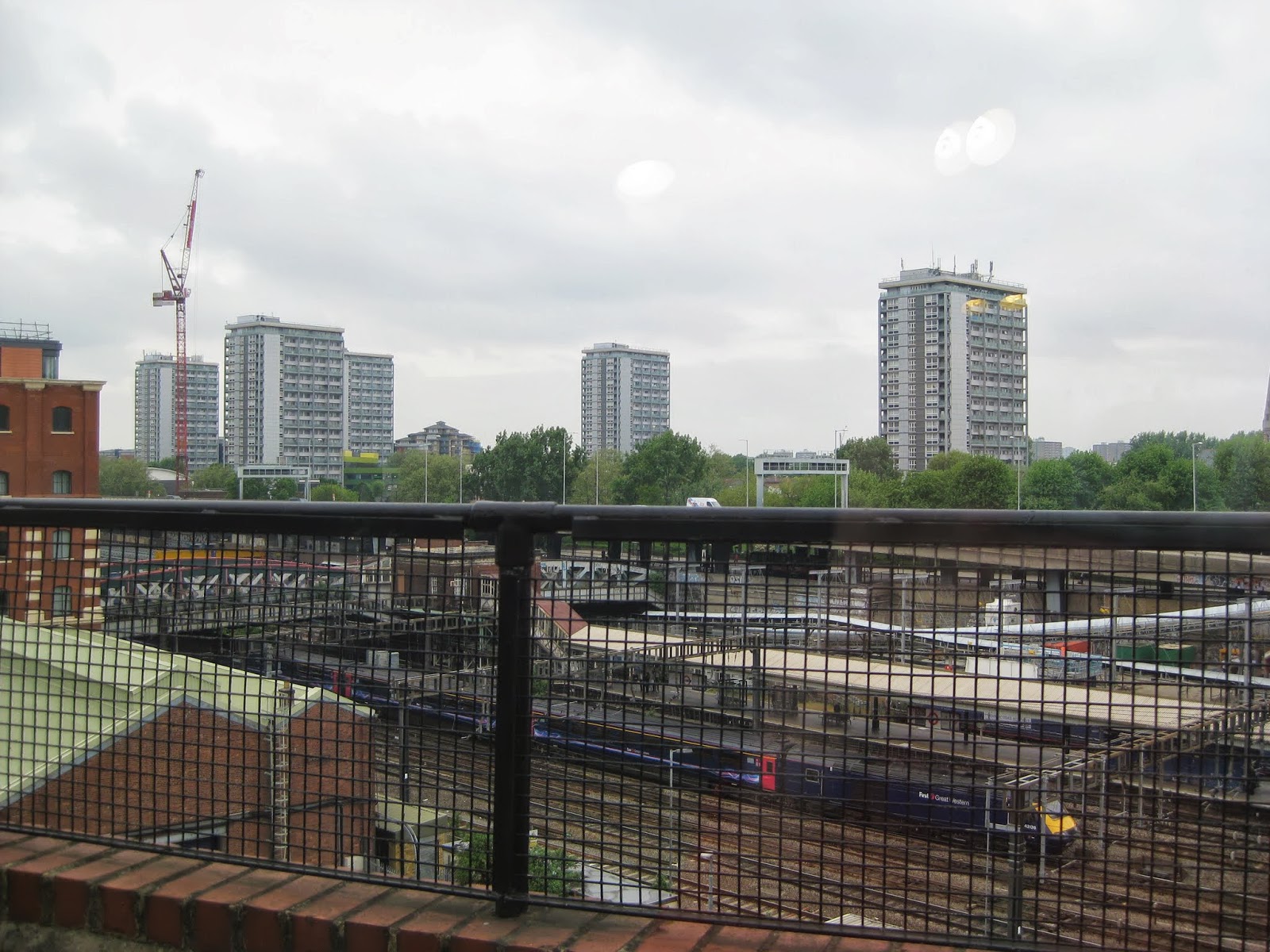
On the very top floor of the elegant four story Gloucester Terrace town house, the tiny guest room  awaited.  Our view was of Paddington Station and its busy rail yard, and at night it still hummed with activity. The clackclackclack of midnight train traffic lulled us to sleep.  It was as if we were travelling north to Edinburgh (a fantasy--no trains leave for Scotland from Paddington) every time we crept into our little bedroom berth. 
    
The train yard by day--our bedroom outlook.

Our perfect, compact bedroom came with a pleasant train-yard soundtrack. 
The Gloucester Terrace flat had an industrial-style kitchen.
Living on Gloucester Terrace with the Smiths created the delightful illusion that we were part of the neighbourhood. We took double-decker buses into town or went over to the Royal Oak tube station to go by subway.  We walked on the high street, enjoyed the gardens, shopped at Waitrose and at Marks and Spencers', and carried our purchases home and schlepped them up the 55 stairs to the flat because there was no lift.  No problem: tourists want elevators, but we had no need.  We were local.

Mews housing in the neighbourhood--so pretty!

St. Paul's ahead! Our view from the front seat....  

A lifetime is not nearly long enough in which to see all that London has to offer, but at least we made a start at filling the gaps in our London Experience.  And while we were about it, the accommodation and the company couldn't be beat.


Did I mention we stayed in a very nice neighbourhood?