Saturday, 4 January 2014

Loving (and Leaving) Spain

I had not expected to enjoy my time in Spain a much as I did.  (We had, after all chosen this holiday only because a friend had a conference to attend.) But love it, I did, although in two weeks there is only so much you can experience.  I am already making a list for next time: hike in the Sierra Madres, watch a flamenco performance, visit the Gaudi (art gallery) in Barcelona.  "Attend bull fight" does not make the cut.  Back in 1964 on my only other visit to Spain (with my friend Loretta) we went to a bull fight and walked out half-way through.  We knew that, one way or the other, things were not going to end well.  

In no particular order, then, this was I most appreciated about this endlessly interesting county:

The People.  I feel so embarrassed even admitting this, but having read our Rick Steeves' guidebook, I was prepared for a nation of pickpockets and thieves.  That tamper-proof man-bag that Bruce carried?  We could have saved our money.  (True, a gypsy woman in Granada tried to give us a sprig of rosemary but we rejected her overture and she moved on.)

The Spaniards we met were lovely.  They were especially tolerant of our fumbling attempts to communicate, and on one occasion came to my rescue as I tried to buy a cup of coffee on a train. A woman passenger had been standing near me in the cafe as I made inquiries about taking a coffee back to my seat.  When the barista seemed completely puzzled by the question, I shrugged my shoulders and went back empty handed.  But then the woman found me, offered to help, and we returned to the coffee bar.  Yes, beverages can be consumed anywhere on a train. But it is worth making the inquiry (even in fractured Spanish) just so you can meet fellow passengers.

The Sun. I love, love love Spanish sunshine.  It seemed more concentrated, more golden somehow than the September sun we left behind in Ontario. No wonder Brits and Northern Europeans have such affection for this country.

Omnipresent Embellishment. Spaniards have a wonderful sense of style, and it seems to me they are happiest when their surroundings are as beautiful as possible. And this applies to everything: buildings, gardens, cement walls, toilet rolls -- all deserve an extra flourish. 


This pretty church is right beside the Prado.
.
Fanned toilet paper seems so Spanish !
    
There are no boring Spanish walls.


The Food.  In truth, we had some really dreadful food when we first arrived in Spain. A dessicated paella full of empty shells will be long remembered for all the wrong reasons. But in the north while we were hiking, we ate very well.  I especially liked the fabada, a delicious bean soup which we enjoyed in several variations.  And our meals seemed to improve throughout the holiday. The final dinner in an airport hotel outside Madrid was top notch.

A tapas market in Madrid offers olives of all sorts.
National Values.  It took the entire holiday to appreciate that Spanish clocks seems to tick at a different pace.  Breakfast is not at the crack of dawn.  A leisurely lunch is acceptable, and shops may close from 12 to 2 in order to facilitate this practice.  These are the habits of a very sociable people who make time for one another.  They value what is really important and enjoy the company of family and friends -- for a drink, a stroll, or a late dinner. And when they get together, they talk.  They are not forever checking their cell phones or texting.

Do things move more slowly in Spain? Here is the evidence: a WALK sign in Bilbao.
***

We took another train from Granada back to Madrid for our return flight, and this time I confidently ordered cafe con leche and took it back to my seat. We watched the Andalusian countryside whizz by -- olive grove, after olive grove, after olive grove. (Surely the Spanish economy must bob along on a sea of olive oil?  Not so, according to Rick Steeves, although olives are a significant crop.)

From the train: olive trees as far as the we can see.
   
Back in Madrid on our last night in Spain I wanted to check one more fact in our Steeves' guide.  But when I rummaged through our backpacks, the book was nowhere to be found.  I must have left it on the train.  Call it kismet.

I bet that another English speaking tourist claimed our abandoned Steeves, and that the book has enjoyed many other Spanish adventures.  I only hope that the new owner didn't' take the advice to guard against pickpockets too seriously.  I wish had written a note (Not in our experience!) in the margins.   


Wednesday, 1 January 2014

Moorish Granada: Alhambra and Albayzin

Granada must surely have the most interesting history of any city in Spain. A last bastion of the Moors in Europe, the city succumbed in 1492 to the armies of the Reconquista,  The Spanish-style Crusade had finally won back the entire Iberian peninsula.  It only took 700 years.

Ferdinand and Isabella (yes, that Ferdinand and Isabella) were the lucky monarchs to enjoy the spoils, and they did, indeed.  Recognizing a good thing in Granada's beautiful Moorish fortress. the Alhambra, they moved right in.  They left the Albayzin, the nearby Muslim quarter, untouched but were not quite so tolerant of its non-Catholic residents.. Conquered Muslims and Jews either converted to Catholicism, fled to North Africa, or risked torture. (Today, tourists wander the streets of Granada admiring its Muslim past, and give very little thought to the horrors of the Inquisition. It is so much pleasanter to conjure Scheherazade-like fantasies as one explores the Alhambra in its park-like setting.)

We walked to the Alhambra and passed this lovely old gate.

Our well-situated hotel was within walking distance of the Alhambra, and we also lucked out with entrance tickets, booking the last 4 available at 11:00 a.m. on a Sunday morning. But we didn't really appreciate the benefit of an early visit until we passed the hot and cranky afternoon line-ups as we were leaving.  Arriving at 10:00 to explore the grounds, we had found this tourist mecca relatively free of tourists!  There is nothing that spoils a world-famous beauty spot (and UNESCO World Heritage Site) like hordes of other admirers.  A morning visit also guarantees cooler temperatures.

That couple at the far end?  They are likely saying "Wow!  There is no one here.  Let's take a picture!"

The Alhambra is not grandiose, but it is very beautiful. Although it was a palace (as well as a fortress) the palatial aspects are best typified not by size or magnificence, but by the elegant, intricate design that incorporates water (in fountains and pools), gardens and opportunities for shade.

Ornament is everything.
A raggy-looking shrub would be so wrong in this space.

Tourists, at last.  They are admiring the Lion Fountain.
Entrance to the Alhambra includes access to the abundant gardens, and one of the prettiest is the Generalife which surrounds a summer palace. It is a beautiful spot and makes one want to rush home to dig water features and plant bougainvillea everywhere. (Though lilacs might be a better choice in southern Ontario.)

The summer palace.  A lone photographer is taking our picture just as we take his.

We took in the Albayzin, another World Heritage Site , on a very warm afternoon and once again we among just a few tourists.  Perhaps they did not relish an uphill slog.  We didn't mind, and we found it interesting to wander through what remained of the old Moorish quarter on our way to the destination lookout, the Plaza of St. Nicolas.

St. Nicolas Church was once a mosque.

A court of mosaic stone in the Albayzin market place. 
The Albayzin may be a "heritage area", but it is also a living neighbourhood.  There are bars, restaurants and shops, and vehicles parked outside homes and apartments. But the Moorish influence is unmistakable, even in Catholic churches that began life as mosques.  Our Rick Steeves' guide mentions 20 mosques in this area that got a Christian makeover, but we only saw two or three.

A busy, un-Medeival market in the Albayzin.


St Nicolas Plaza offers a lovely view of the Alhambra.  Everyone else thinks so too.


Wednesday, 11 December 2013

Lost in Granada

Granada was so consumed by the 20th International Congress of Nutrition that we felt enormously grateful to have found a tiny out-of-the-way hotel, a last minute hotwire choice that was far from the conference centre.

But we had lucked out. The 3-storey Arabeluj was a charming boutique hotel perched on a hillside.  A terrace, perfect for breakfast and end-of-the-day-tapas, overlooked the city.

From the terrace at dusk.

The Arabeluj was also within walking distance of the Alhambra and most everything else listed in our Rick Steeves' Guide.  That the walking was entirely uphill (or completely down, depending on your direction), was of no matter: we had Picos' mountain-walking experience.

Granada's houses are built on hillsides. 

Shamelessly clutching our city map, we set out through streets that are narrow, twisting and poorly marked.


It is very easy to get lost in Granada. And we did.  Frequently.

Don't be fooled.  Bruce is lost.

But getting lost does have its advantages. We discovered, by accident, aspects of Granada that are not in any guidebook. We observed uniformed  private school students arriving at wrought-iron gates in fancy cars.  We followed elderly nuns as they went shopping.  We saw Spanish families out for a Sunday afternoon stroll.

Having left the convent, this nun is now going to the butchers...
...followed by six knowing cats.  (Two are already around the corner!)

Three generations enjoy family time ( and dressing up).
We found parks and fountains, tiny courtyards, and an abundance of graffiti.  For whatever reason, every wall and building appears to be some sort of public palette.  Graffiti are everywhere!

This grafitti-ed corner was right by our hotel as we walked into town.
Not all graffiti was attractive.

There are plenty of graffiti on abandoned buildings, and we saw a few of those.  The economic downturn has not been kind to Spain.


Abandoned office block in central Granada.

One of the largest empty office towers once housed a bank.  It is right beside a favourite downtown meeting place (and bus stop),  Plaza de Isabel la Catolica.


You would think this plaza would be easy to find -- it is beautiful, large, central, and the statue of Isabella, Ferdinand and Columbus is tall and impressive.  But it is not the only imposing plaza in central Granada.   After three days we finally learned to walk there without having to backtrack or go once more around the block!
  
Plaza de Isabel la Catolica.  Guess which is the empty building?  The new (ugly) one.  


Friday, 22 November 2013

And Now, Bilbao

There was a time when tourists avoided the port city of Bilbao--if they knew about it at all. Back in 1964 on my first visit to Spain, it was certainly not on my radar.  

Then in 1997, along came architect Frank Gehry with a building that looked like a futuristic origami project made of aluminum foil.  Now, if you announce "Our next stop is Bilbao", everyone knows you aren't going to the city.  You are going to the art gallery, aka Guggenheim Bilbao.

And from the Picos, it is a short hop. If you get all the connections lined up, it takes about 4 hours or less.  We however did not have such luck, and wound up having to wait for three hours in Llanes.  
We could have done worse.  This little port city is quite picturesque, so we wandered around, camera at the ready.

Llanes
By the time we got to Bilboa, it was late afternoon.  But we were not deterred.  Our hotel was close to the Guggenheim, and since we were in Spain, we knew that we would not be late for dinner even if we turned up at 9:30.  We had plenty of time to thoroughly explore the art gallery and its environs. before searching out a restaurant.

We discovered, en route to the holy grail of galleries, that the city has happily embraced its arty side. 

"Bilbao"
We couldn't help but think that the Toronto waterfront could use this sort of upgrade.  The walk to the Guggenheim gallery is beautiful, and features gardens, sculptures, and interesting civic architecture.

Puppy, covered with living flowers, greets gallery goers.

I love this sculpture!


No ordinary bridge...this is one is gallery-worthy 


Even downtown Bilboa seems to know it should look good for visitors.

Early Sunday morning in Bilbao.
Take time to admire the city...and while you're at it, amble across the intersection!

Friday, 15 November 2013

The Final Hike!

If we wanted to complete the circuit and get back Arenas, we first needed to find our way to Poncebos where the S-cape van would pick us up.

We would not be taking the precipitous route down from the refuge at Urriellu, however.  We would take the long route down -- one that went from Sotres to Poncebos (via Collado Pandebano and the tiny village of Bulnes) and to our rendezvous at the bar, Garganta del Cares) .

At Collado Pandebano again.....

On tarmac roads and farm tracks we tramped from Sotres to Pandebano. Then with Urriellu to our left,  we headed down the valley.
Down hill and into the trees and bracken...

The entire walk was about 12 kms, and although technically not difficult, it was demanding. Vague directions such as "take care not to miss fork at end of walled meadow" did not encourage appreciation of whatever vista lay ahead. (We did not miss the fork, but discovered later that others had.  We asked about their GPS.  Wasn't it working?  Yes it was.  At the bottom of a knapsack.)

Then there was the middle section of the track which our notes described as "long, steep and tedious".   And rocky.  The track was entirely composed of boulders and rough stone.  We thought it might be a stream bed, but the rocks were arranged far too regularly to have been placed there by the hand of nature. A Roman Road?  We knew that Christians hell-bent on re-claiming the Iberian peninsula from the Moors came this way on the Ruta de la Reconquista.  It tried to imagine sandled feet on this unpleasant, uneven surface.  No way. Those holy warriors must surely have ridden horses or donkeys.  (I would have gladly traded my excellent Zamberlan hiking boots for a donkey.)

This tedious trail descended downhill for several kilometres.

Tiny Bulnes has 3 bars and not much else. We noted the bars.  We did not visit them.

We arrived in Bulnes in time for lunch.  But no leisurely drinks were consumed at any of the three bars; we perched on a stone wall by the side of the trail and gobbled down our cheese sandwiches.  We needed to pick up the pace.  Bruce was absolutely convinced that we would be the very last hikers to arrive in Poncebos. We envisioned the others loping down the mountainside from Urriellu. No. They were probably already in Poncebos having a celebratory beer.  

Hop to it, Ryans!

The last four kilometres, along another spectacular gorge, were undoubtedly the best part of the walk.  The path overlooking Canal del Textu gradually descended while snaking along ledges far above the water .  It was deemed "not suitable for those afraid of heights" but we were in such a rush we hardly noticed.  We almost forgot to take pictures.

Our last descent....
The Puente del Zardo, where the trail crosses to the other side.
Just a few more steps to the Bar Garganta del Cares 
At about 3:30, we arrived at the bar expecting to join our friends. But the place was empty except for one other couple that we recognized from the hotel.    They had not come from Urreillu, nor had they walked from Sotres.  They had shortened their route somehow and were now relaxing alone at an outdoor table.

So.... where were the others?  We twiddled our fingers, we had a drink and finally we phoned S-cape and asked about the rest of our group.  No one had seen Roz and Ian or the Dutch hikers.  We all concluded that they would be picked up later since they were probably still on the trail. I generously did not make a point of discussing this detail with Bruce.

At about 6 that evening we heard Roz and Ian's story of walking directly down from Urreillu.  Of the 30 or so hikers at the refugio, they were the only ones to take this path.  Our four Dutch friends gave it a try and turned around when they came to a tricky section that involved rock-climbing down a cliff.  (No ropes. Nothing to grab onto-- just careful placing of fingers and toes. No way!)

Roz and Ian confirmed that it was a difficult, steep, badly maintained track, and that we had probably made the right decision.  The descent had taken them twice as long to complete as they had anticipated. 

But they did it!  And we were not surprised.  At 70+ they are fit and have loads of stamina. 

Yeah Gibsons!! 

Roz and Ian Gibson.  Super hikers, married 50 years!
      

Saturday, 26 October 2013

A Perfect Picu: Naranjo de Bulnes

We had walked into Sotres and we intended to walk back, returning to Poncebos so that we could get a ride to Arenas where we had started our circular hiking holiday 10 days previously.

But first we had to climb to the Vega de Urriellu (a mountain refuge) at the foot of Naranjo de Bulnes, one of Spain's most iconic picos.

Climbers go to the top. We just intended to go to the base of this famous peak.
We intended to stay at the refuge, and then walk back down.

But then I noticed a detail in S-cape's notes about the return from Urriellu to Poncebos.  Descent:  1900 metres.  Hmmmm.... what I recalled from my first cursory reading of these notes (back in Guelph) was Descent: 900 metres.  Very do-able.   Where did that extra 1000 some from?

 Aaaagh!!

I am probably capable of descending 1900 metres, but I knew that the track would be tricky as well as long and steep.  I also knew I would need to proceed at my own pace, and I didn't want to slow  fellow hikers who would also be walking down from the refuge.  So....feeling a bit wimpy, I bailed on our night at the Vega de Urriellu, and came up with a new plan: walk to the refugio, return to Sotres, spend the night in the hotel, and walk the next day from Sotres to Poncebos on a different route.  Truth to tell,  Bruce was fine with this new scheme.  He knew that the refuge was unheated, without electricity, and that we would be sleeping in bunk rooms with up to 100 strangers.

In order to shorten the walk, Roz and Ian and Bruce and I took the S'cape SUV to Pandebano, a mountain valley that is the standard starting point for most hikers heading for Urriellu.  We could walk the 5 kms to the top and return with plenty of time to pick up our ride back to Sotres.
Urreillu beckons as we began the trek from Pandebano.
No looking down!


That's Roz chugging up the track. 
Almost there...


Then Bruce began to worry that we would not get back to Pandebano in time to meet our S'cape driver.  So after a hasty lunch among the rocks, we sent Roz and Ian ahead to the refuge and we began the descent.

The return was faster than we anticipated.  Perhaps we were more familiar with the track. Or anxious to keep our 5:00 o'clock deadline.  We were also being pursued by a huge gang of eager, curious goats who wanted to be our new BFFs. We were not quite so keen. They must have known about the lunch leftovers in our packs.

Lunch?  Did someone say lunch?
    

On the way back....
....to Pandebano.  We arrived an hour early. 


That night, we were the only S'cape couple in the hotel dining room.  Ordinarily the staff prepared one standard (and very nice) multi-course, meaty meal for the entire group.  But as their only guests, we were given soup, a main course (omelet and vegetables) and dessert (flan, rice pudding or ice cream).  This was the first time we had been served vegetarian fare (very likely prepared for convenience) but we put it down to Bruce's directive each day for our packed lunch: "por favor un picnic con bocadillos de queso. No carne."  We weren't really being picky.  Our cheese sandwiches were tasty enough without the addition of salami.

And so was the omelet, washed down with an entire bottle of very drinkable red wine.  The standard S'cape dinner for 2 to 4 people always came with a bottle of wine!

We thought of Roz and Ian in their chilly mountain-top refuge.  I had loaned Roz my long woolen sweater.  At least I could claim that it stayed the night on Urreillu even if I was sitting in the warm  hotel dining room drinking Roz's share of rioja.            

Monday, 21 October 2013

Trekking from Sotres

From Sotres, we were able to access some really marvelous hiking trails.

Back to Sotres at the end of the day.

At lower levels, we went on picturesque farming tracks and footpaths through beech woods and meadows.
Don't disturb the horses...

Following other paths, we climbed beyond the tree line into a landscape of rock and sky.

An elemental landscape

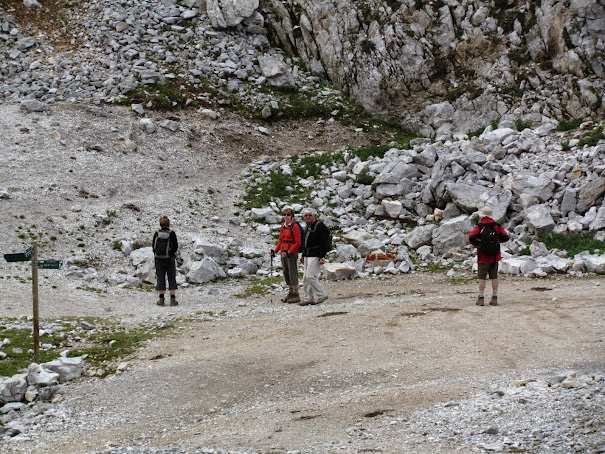
In spite of the signposts, we are about to become lost.  (photo supplied by fellow hikers, Arjan and Amke)
The three mountain masses (massifs) that comprise the Picos are of limestone, which makes for much different experience than hiking in the mostly-granite Rockies.  Limestone erodes in rainwater, so we saw interesting formations -- caves and sinkholes, but no tarns (small mountain lakes) and no waterfalls.  No wonder we sometimes felt as if we were hiking in the mountains of the moon.

What did make the walks above Sotres interesting was evidence of mining.  These lead and zinc mines closed down in the early 20th century, but horizontal shafts, tailings ponds, abandoned equipment, and even a few empty houses still testify to an industry long gone.


Through the arch to the Rufugio de Andara...locked and unoccupied.
 
A mining ghost town