Thursday, 17 October 2013

Sotres Sojourn

By the time we hiked over to Sotres the weather was gradually improving. Good. We were to have 3 days of trekking from this new location.  Although the fog lingered, at least it was not raining as we made our way on farm tracks and cattle trails from Espinama through the Aliva valley.

Ermita de Aliva.  This lonely trail-side chapel is only open on holidays.
 
No fertilizer/fertilizer?  We decided that these are grazed and ungrazed fields.
Sotres is the highest village in the Picos.  We trudged uphill on a tarmac road and found the tiny town perched on a cliff, overlooking a valley.   The main street seemed to consist of nothing but a few bars and hotels clustered around a recycling centre and a public laundry/wash-house. 

 Sotres is perched cliffside (stock photo).

Our hotel, Hotel Sotres, was on the edge of town but easy to find.  No GPS required. 
Looking down the main street from our hotel.  The single storey wash-house is surrounded by SUVs..

We had all our meals at the hotel, and they even made us lunch.  This was just as well since there appeared to be no grocery store. (One souvenir shop sold cheese, t-shirts, and scratchy hand-knitted woolen socks.)  We asked about the lack of amenities and were told that supplies were available at an outdoor market once a week.  Bread was delivered daily.   We confirmed this at breakfast as we watched the arrival of the bread truck from the dining room window. It came and left in about 5 minutes.  Had we wanted a loaf of pan we would have had to be very quick.

A farm on the outskirts of Sotres appears to have arranged for bread delivery
We walk back into Sotres after a day on the trail.
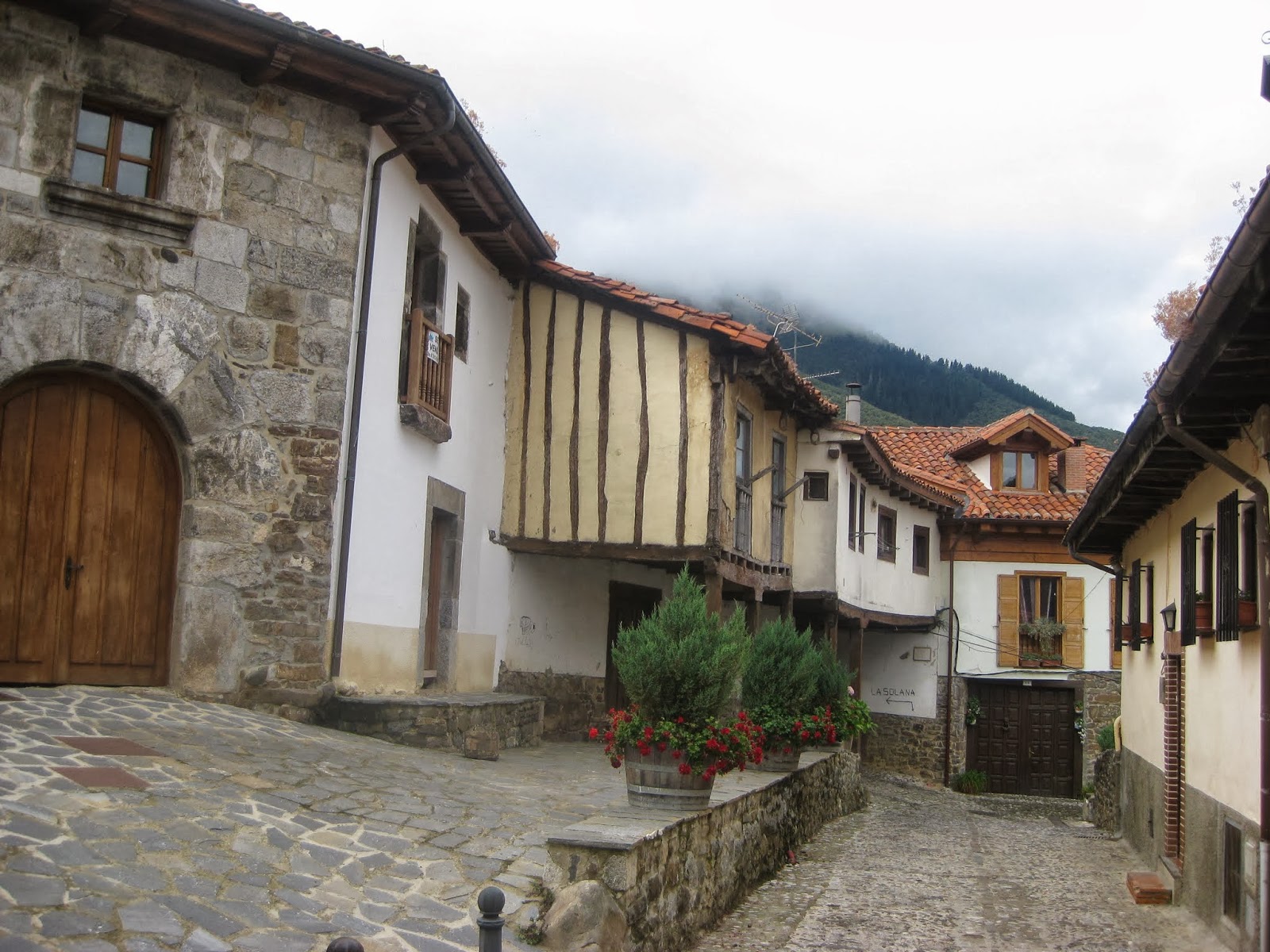
Although the main street offered very little, the village itself was pretty with small houses and apartments on the nearby streets.  I walked around the town and formulated a few generalities:

1. New or old, all village houses look alike with stone/stucco walls and tile roofs. (There must be municipal guidelines that enforce this rustic consistency.)

Stone walls, tile roof and flower boxes: check, check and check.  
This house had a solar panel, and a pretty garden. Extra points.
2.  Most residents are male and middle-aged, and at 6:00 pm they are all in the bars having beer and tapas.  Where were the women?  My friend Roz thought she knew.  They were at home preparing the unnecessarily large, multi-course dinners that would be consumed at 9 o'clock!

3.  Most residents own SUVs.  For such a small town there seemed to be an overabundance of vehicles, but I suppose people need to have a way to get to work or school, or just visit the dentist or get their hair cut.  Visiting hikers are surely the only ones hoofing it in and out of Sotres.   

When our S-scape representative Marie  dropped in to the hotel I asked her what Sotres was like in the winter.  Was there enough snow to support ski tourism?   There are very heavy snowfalls, she told me, but Sotres is close to the coast and the snow melts so quickly that it can be dangerous. There is very little skiing.

In fact, she and her family will be moving to Arenas for the winter so that her children are not at risk from avalanches as they are driven home from school.  She added that many people leave for the winter. If they are lucky they find seasonal work in Bilbao or other towns on the coast. Only about 60 residents remain behind.

I hope that weekly market is year-round;  I hope the bread truck has winter tires!    

Tuesday, 8 October 2013

Potes: a medieval town in the Picos

After four days of extreme hiking, we were more than ready for a day off.

We could have simply made excuses and wimped out.  But there was no need.  We were rescued by the weather.   A welcome rainy day provided a legitimate excuse to seek a non-hiking option, and luckily there was a very good one nearby.  Potes, a well-preserved medieval village, was just up the road from our new home base in Espinama.

Let it rain....we will explore Potes
The River Deva
Potes is old in a way that is almost incomprehensible to Canadians. (Once upon a time, I recall being very impressed that an Edmonton friend lived in a really old house --built 40 years ago!)   But Potes was already experiencing a building boom in the 9th century when the Romans took advantage of its strategic location at a confluence of four valleys and two rivers.

A former mill on the Deva

A very old wall spans a very old street
Most of the buildings that now give the town its character, however, date from the 15th century and later.  Their exteriors appear largely unchanged, so what remains is a picturesque, historic little town. And it is little. Only 1,500 people live here.   

Nevertheless, the information bureau in the main square is huge -- an indication of just how many tourists love authentic rustic charm.

Potes on a rainy day

Medieval "row houses"-- still occupied.

Potes is no living history museum, however.  Wander through the narrow, twisty streets and you will be walking where the locals live, shop and do business.  These residents must surely feel annoyed that nosey tourists unabashedly gawk and take photographs of their private spaces.  Unless they own a cafe or souvenir shop, that is.

Tiny shops on tiny streets

Because after we have peered around every corner, admired every flowery window box, and walked down every cobblestone lane, that is where we will be hanging out, avoiding the rain while we wait for the bus.

We watched a standoff between a Mercedes and a BMW at this narrow corner.  The Mercedes won.

Tuesday, 1 October 2013

Walking the Cares Gorge

Three days into our Picos adventure, we tramped along the Garganta del Cares, aka the Cares Gorge. 

This spectacular walk follows a channel carrying water from the Cares River to a hydroelectric station. The path was originally built in the 1920s as a service route for the canal, but now the Ruta del Cares has a new life as one of Spain's most popular outdoor destinations.  Thousands of tourists visit the Picos every year just to notch this 12 km hike on their "great-treks" belts. 

And no wonder. The scenery is breathtaking.   The precipitous limestone chasm is unbelievably deep (over a km in places), and it rises majestically above and below the track.
How far down?
The path is equally impressive. Cut into the chasm, it snakes along narrow ledges and through dark tunnels.  Occasionally a hand-rail provides a bit of security, but otherwise, hikers hold their breath, avoid looking down and push on.

There are gangs of goats along the Cares Gorge, too.

A National Parks sign at the start of the track warns acrophobics that this edge-y walk will present challenges.  Has anyone ever fallen?  I thought of recent news items about hapless hikers.  The one who fell to her death at Mount Nemo on Ontario's Bruce Trail.  And the woman whose body was consumed in mere minutes by griffon vultures after she plummeted off a cliff in the Pyranees.

I tried not to think of these incidents.   But I couldn't help scanning the cloudless sky above the garganta for large birds of prey......


The sign means exactly what you think. Maybe this is not such a good idea.
No looking down!
Tunnels on the trail
Ian is now the subject of a stranger's Picos pic.
Bridges cross to the other side.

Except for the necessity of keeping to the path (and not falling off the edge), the most challenging aspect of this walk was the temperature -- 32 degrees with no shade at all.  The sun beat down and reflected off the rocky path and the surrounding cliffs.

Our lunch stop (at the end of the gorge) in Cain was a welcome respite, but then we slogged on.  We still needed to reach our next hotel in Posada de Valdeon, 8 kms up the road.

Shade!  We have a lunch of bread and cheese in Cain.
The final 8 km occasionally took us onto a road.  It was less exciting, but the scenery was still impressive.

Our 20 km "bucket list" hike was over.  Finally we could melt into chairs at the Hotel Picos de Europa and practice a lispy request for "uno cervaza (ther-bay-za) por favor".


Saturday, 28 September 2013

In the Picos: Flora, Fauna and Other Signs of Life.

European mountains are not at all like the Rockies of my childhood, and the differences are not hard to spot.  Even casual hikers, without reference to geology or history, can easily identify what makes these Old World mountains unique.  The Picos, for example, are somehow "prettier", especially at lower altitudes. The landforms are softer and trees and flowers are in greater variety.  And compared to the Rocky Mountains they are certainly less wild,  more accessible, and much more domesticated.   People have made this place their home for centuries and longer--and the evidence is everywhere.

The ubiquitous SUV.  Not what we expected to find after we slogged our way to the top....  

How would you know you were in Spain's most famous mountains (and not in Banff National Park)?  Easy.  These three features distinguish the Picos:

The Built Environment  
In the Picos, stone is the favoured building material. There are stone paths, stone fences, and stone buildings.  If it is any kind of building at all, it will be made of stone with a tile roof, and it will likely be on the hiking trail.

An abandoned mining town entirely constructed of local materials
Not a concrete (stone) chaise conveniently placed by the trail but an empty cattle trough.  
This stone church, which is open on holidays, stands alone in the middle of nowhere. 
Picturesque, falling-down stone barns are everywhere.

The Vegetation
I didn't know what sort of trees would grow in these mountains. But at lower levels where the climate is almost Mediterranean, we passed through oak and beech forests and Ian recognized a hornbeam, a tree I knew only through literature. 

As for flowers, it was so late in the season I expected none at all. We could see evidence of summer blooms: drifts of spent wildflowers and numerous hip-covered rose bushes festooned the trails and nearby meadows.  We could imagine how beautiful this region would be in July, but the walking would have been unbearably hot.  In September, we enjoyed cooler weather and even a few flowery surprises.
Heather was in full bloom. 
     
The Spanish name of this low-growing autumn crocus means "picnic time is over."
The last of the summer poppies. 
The Wildlife
The S-cape literature actually suggested that hikers might encounter wild animals -- boar, deer, marten, badgers, foxes, wolves, and bears--though perhaps not during the day.  Bears?  Small Cantabrian brown bears, apparently. But I was skeptical.  I was pretty sure I would not be seeing any bears, or any other wild creatures for that matter. But I could guess the sort of wildlife that we would  encounter. 
    
Elk? Deer?  What are these horned creatures?
Bruce makes a friend.  (This horse always hangs out in the same spot on the trail.  He is looking for treats) 

Who needs to see a griffon vulture when this handsome fellow walks across your path?
Lunch?  Do someone say lunch?  A huge goat gang swarmed us on the trail. 
These are Asturian sheep. They have lovely long legs but scratchy wool.
I asked our S-cape contact Maria about the promised wild animals, and I listed all the farm critters we met while trekking.  "Well", she said,  "we know there are wolves. One of them took a sheep last night."  Oh dear. So sorry for your loss, ewe guys. No wonder that trail-side flock had seemed nervous.

One domestic animal was a night-time fixture for our entire Spanish sojourn. You might say this creature dogged us.  From Madrid to Granada, and in the Picos for sure, a faithful mutt outside our window barked and yipped and howled and whimpered. All night long. By the time we got to Granada and heard the same midnight welcome, I was convinced that our personal Picos pups had been in touch with their doggy southern relatives: Say HELLOOOOOO to Bruce and Nancy!  We LOOOOOVE them!

MUTT:  Please forgive my barking. I am a dog.  It is what I do.  NANCY:  No problem at all, sweetheart!  I got used to it.  You are probably just lonely. Would you like to come home with me? 


Friday, 27 September 2013

Hiking in the Picos de Europa

When we told folks we would be hiking in Spain, they immediately assumed we were going on one of the Camino de Santiago's famous pilgrim routes.  "No", I would respond, hoping that I didn't sound too worldly. "But we are hiking in mountains near the Bay of Biscay not too far from pilgrim paths."

Did that count?  I don't think so.  No-one had ever heard of the Picos de Europa.

We only had 12 days for the hiking part of our holiday. That wouldn't get us far on the 800 km Camino, but we could readily hike 90-or-so km from village to village in the Picos. We were, after all, looking for a (mountain) peak experience: inspiring scenery, alpine flora and fauna,  physical challenge and perhaps a few thrills as we traversed a narrow ridge or negotiated a precipitous descent.  The Picos offers all these opportunities and also the pleasure of exploring the tiny villages in this unique region. 

Scenery to soothe
and inspire.


When hiking in Europe we are usually completely independent;  we make our own arrangements, cook our own food, and plan our own itinerary.  This time, however, we decided to contract out some of our chores to one of several companies who organize outdoor adventures in the Picos. They would book our hotels (and meals), make sure our bags arrived on time, and provide an itinerary for 10 days of trekking that would take us from one central location (Arenas de Cabrales) to three other mountain villages and then back to Arenas.

On the trail above Arenas
 
We wondered if, in our dotage, we were selling out by having S-cape do the heavy lifting for us. But we soon discovered we were not their only customers.  All the younger hikers who were walking this circular route had also organized their holiday through this is or a similar company.  It was the only sensible option, and it guaranteed a good meal, a decent bed, and no huge packs to carry.

Most importantly, our thick package of S-cape materials included detailed maps and directions for all the self-guided adventures we might want to experience-- treks that would allow us to explore a new destination for a day or two, and treks that would get us to our next village following a combination of farm tracks, back roads, marked hiking trails and ancient stone footpaths. The lengthy notes with directives such as "Walk through archway with old mining wagon on top.  At fork go right (stony pathway, up hill toward hut) for 50 metres" would ensure that we always knew where we were.  That was the theory.  It worked most of the time.

But one one occasion, while hiking toward Pico San Carlos, we did not go right.  We went left and eventually found ourselves lost and alone in a moonscape of rock and sky.

Is that the Bay of Biscay in the distance?  One rock looks like another, and we have made a wrong turn...   
We eventually found our way down.  But we learned a lesson: Follow Directions.  The hiking might be "self-guided",  but it is nevertheless ill-advised to become creative while interpreting the instructions. 

Ian consults our maps.
After a full day on the trail we enjoyed comparing trekking tales with the other younger S-capers. We particularly enjoyed talking to Gerda and Anton and Amke and Arjan.  They were Dutch and their English was very good (our Dutch was worse than our Spanish), so they understood perfectly when we asked if they had had trouble finding their way out of Collado San Carlos. "Oh no", they assured us.  "We have GPS".

 Youth and GPS?  Life is so unfair.     

Saturday, 21 September 2013

Magnificent Madrid

Having prepared inadequately for our trip to London earlier this year, this time I did my homework. To this end, I more-or-less memorized the important bits of Rick Steves' Spain. With only two full days in Madrid, I knew exactly what we should see and do: visit three art galleries and one palace.  Hang out in the main square.  Explore the old town.  (I also knew that the agenda would not include any kind of shopping -- no visits to markets or the huge and tempting El Corte Ingles department store. Best to get that into my head from the start.)

In any case, who had time to shop?  Madrid is a magnificent city for galleries!  Even tourists who don't like art should take time for:

Prado.  After the Louvre, the Prado is the best art gallery in Europe, and (no surprise) the very best for Spanish artists:  Jean Miro, El Greco, Goya, and my personal favourite, Velasquez  He captures the personality of his subjects so well that you pay attention to the person, and not just to their over-the-top baroque wardrobe.

Thyssen, aka the Thyssen-Bornemisa. I had never heard of this gallery but it has a fine collection of impressionist art, and because it is not the Prado, it is not a tourist mecca. Rick Steves' observes that the Thyssen has "lesser art by great artists, and great art by lesser artists".  That means you will not have to wait your turn to see that gorgeous Van Gogh, the one you didn't even know existed.       

Reina Sofia.  In a word: Guernica. Even if you can't stand Picasso, you need to stand in front of this huge, controversial painting -- one of the most important art works of the 20th century.

And then, 20 minutes from our hotel in the other direction, there was El Palacio Real.  By the time we got to the Royal Palace, we were accustomed to pretty buildings.  Madrid is a showcase for classically baroque architecture, but the palace, completed in 1755 and still in use, outdoes them all.  It is uber-ornamented. Thank goodness we did have not go through all 3,000+ rooms.

A portion of the pulchritudinous palacio. 

As it was, we saw enough rooms, chambers and anterooms chockablock with painted rococo ceilings, gorgeous furniture, china and clocks (the royal family apparently has a thing for timepieces) to bring on a diabetic coma.  I rather liked the un-ornamented pharmacy with its shelves and shelves of tidy jars and  hand-labelled pots and bottles.  Had I been the queen, I would have sneaked down there just to clear a brain overstimulated by too many cupids and pink clouds.
 
Our own antidote to wedding-cake architecture was a walk through the old quarter just outside our hotel. 


Our tiny hotel, El Pasaje, was on a tiny street.  If a car had come by, Ian would have had to jump into the doorway.

Some of our neighbourhood establishments were very picturesque indeed, even if they were merely old and not baroque. The charming bookstore and nearby Villa Rosa flamenco club are among Madrid's oldest businesses, apparently.  A few tiles, intricate stone work, some flowers and fancy grillwork = rustic charm.

Ros, Ian and Bruce check out the bookstore.


The Villa Rosa, with its totally tiled facade, is a great place for flamenco.  Not that we went....

We did take a break from our museum and gallery-going to join all the locals in the huge Plaza Major for drinks and tapas on a Sunday afternoon.

See and be seen at the Plaza Major, and bring the family!
We ate, admired the architecture, watched people come and go, and checked out the buskers. There were some very strange street entertainers in the Plaza, but none weirder than a sulky, overweight Spiderman.  I'll never know what he was up to -- he sauntered off while we watched.  His Spidey-sense must have told him it was time to find another web.

That's Spidey in Plaza Major having a smoke break.

***
Travel Tip:  Unless you really are doing a walk-through in a gallery or museum, get one of the hand-held audio-guides.  Find the number attached to a work of art, punch it in, and listen. Without the need to focus, we would have wandered from room to room for two days, learning nothing. 

Hola Espana!

Spain?  Really?

It's true. It had not occurred to us to consider Spain as a holiday/hiking destination until we knew that our NZ friends, Ros and Ian, were going to be there for the 20th International Congress of Nutrition.  They convinced us: September was the perfect time to visit.  There would be great weather and fewer tourists (unless you count the 4,000 nutritionists). We could hang out in Madrid for a couple of days, head up north for some spectacular hiking in the Picos de Europa, nip over to Bilboa for shot of culture, and then end our trip exploring Granada--providing congress attendees left us at least one empty hotel room.

We were easily persuaded, and we did have a wonderful holiday!

By the time we packed our bags to leave, we had even adapted (sort of) to peculiar Spanish meal times. Ros noted at that eager American delegates at the Congress were waiting in vain, all hopeful, for breakfast at 7 a.m. The more usual 8:30 desayuno suited us just fine, but it took our entire holiday to convince our stomachs that a 9 p.m.dinner-time was acceptable.  Any earlier and we were marked as tourists. We might as well have walked into a restaurant in head-to-toe Tilley, with a Canadian maple leaf sewn onto our backpack.  

They knew we were tourists; no need to advertise.